SysML Repo Modeler is now open source and free to use. It turns one GitHub repository—or many—into an explorable SysML v2 system model. Get the code on GitHub.
It gives us a coherent way to visualize our own repositories, services, APIs, and layers of institutional knowledge in an exploratory systems view. And now it’s open source for anyone to freely use.
Explore a Live Model
Want to see the result before getting into the details? Start with the live Supabase Platform model, which maps five repositories and four languages as one system. You can also explore the OpenClaw model, the n8n model and the Ollama model. All four sit side by side in the SysML Repo Modeler gallery, with the repository, part and connection counts for each.
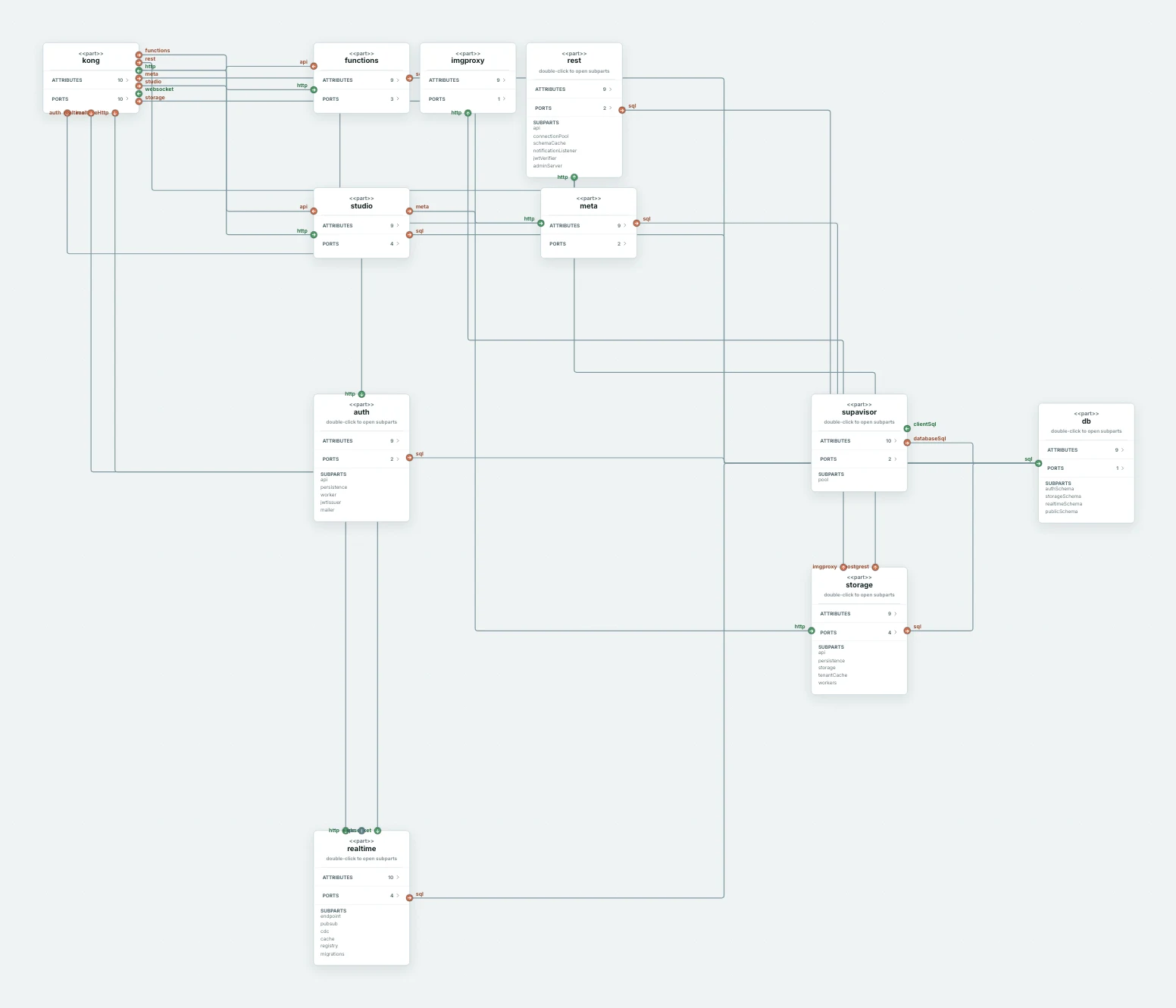
Open the live Supabase Platform model — click the image to search, filter, and explore the system.
The Problem: Architecture Lives in Too Many Places
The reality is that modern systems are scattered across multiple repositories, services, APIs, and layers of institutional knowledge. The challenge is not that teams lack documentation; it is that documentation struggles to keep up with what the code does.
Traditional Model-Based Systems Engineering (MBSE) documentation can be useful, but it is often manually maintained across disparate software platforms that require significant user knowledge and training, with limited ability to transfer data between tools. As a system evolves, the diagram becomes a snapshot of what people thought a system looked like but not necessarily what exists now.
Why Visualization Matters
Graphs are not just there to paint a pretty picture; they are there to provide a strong understanding of what exists. A complex system is difficult because there are so many moving parts, dependencies, and integration paths that are hidden inside the source code. Visualizing a system gives insight to a user in a way to see structure, spot unintended connections and trace relationships between systems. This takes tribal knowledge into something reviewable, discussable, and easier to improve on.
A generated system diagram provides several practical benefits:
Developers can quickly see how repositories, services, and APIs connect.
Architects can validate design assumptions against the actual implementation.
Teams can reduce onboarding time by giving new engineers a clearer view of the system.
System knowledge becomes less dependent on a small number of engineers.
Teams get better traceability and rely less on guesswork.
Turning Code into a System Model
SysML v2 is a recent system modeling language made by the Object Management Group (OMG) that allows system architecture to be defined and written as machine-readable code. What makes this useful is it supports both textual and graphical modeling which makes it better suited for automation, code analysis, AI-assisted workflows, and tool interoperability than older diagram-first approaches.
How SysML Repo Modeler Builds the Model
SysML Repo Modeler works by combining repository analysis, prompt-guided AI reasoning, and validation into a repeatable modeling pipeline. A project can include one repository or many. The tool imports or syncs each repository into a shared project workspace, records metadata such as branch, commit, path, and status, and then presents the repositories to OpenCode as parts of one system rather than as isolated codebases.
That multi-repository context is important because architecture often lives in the relationships between repos: one service calls another, one repository owns deployment configuration for several services, and shared infrastructure may only be visible when the project is viewed as a whole. SysML Repo Modeler gives OpenCode the repository paths and extracted evidence together, so the model can include cross-repository components, shared dependencies, external services, and the connections between them.
The model generation happens in multiple passes. The first pass focuses on structure: identifying components, ports, dependencies, and connections. A second pass enriches that initial model by adding purpose and detail, such as what each component is responsible for and how parts of the system interact. After OpenCode produces SysML v2 text, SysML Repo Modeler validates the output to make sure it is usable by the renderer. If the model is incomplete or malformed, the system can run targeted repair or coverage-improvement prompts rather than starting over from scratch.
The result is a generated SysML v2 model that can be rendered as an interactive graph and reviewed as code. This keeps the process grounded in the actual repositories while still allowing AI to do the heavy lifting of reading, connecting, and summarizing the architecture. It is not meant to replace engineering judgment; it gives teams a faster first draft of the system model that they can inspect, refine, and regenerate as repositories evolve.
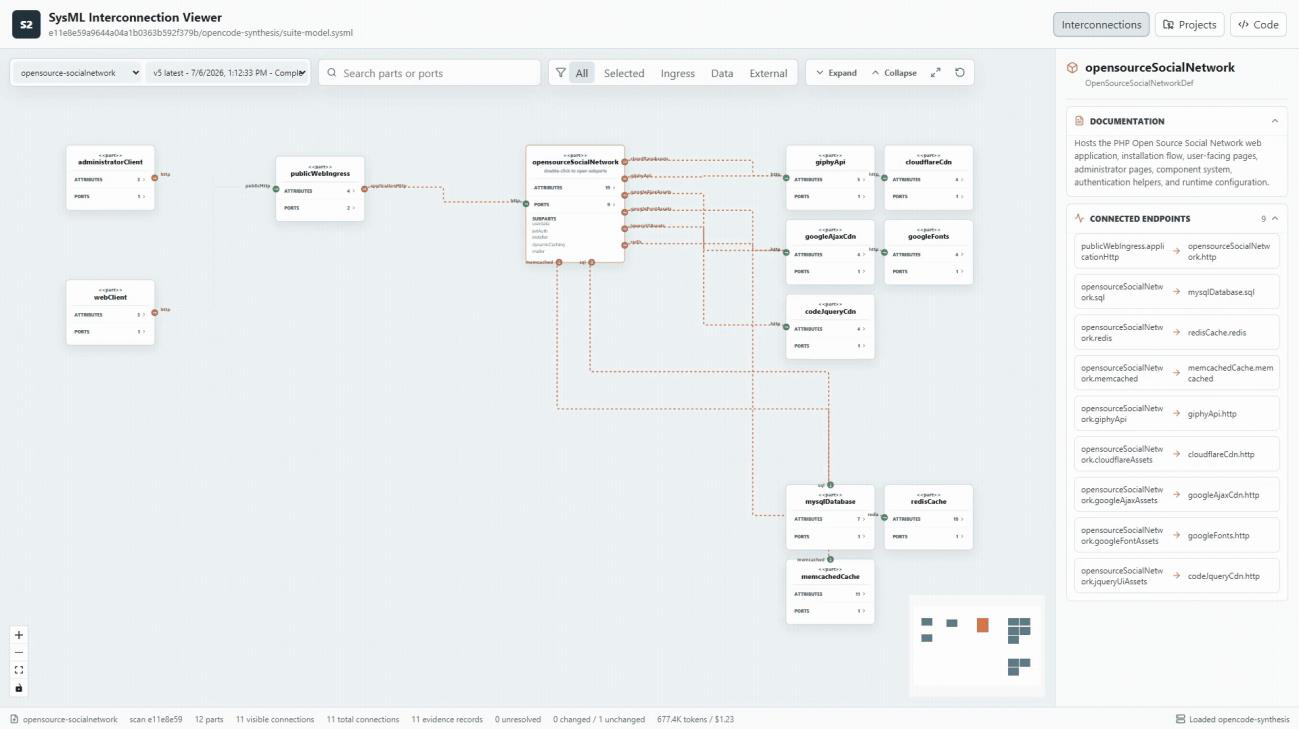
The generated model rendered as an interactive graph, with documentation and connected endpoints alongside it.
SysML Repo Modeler Scan Cost Example
As a concrete example, we ran SysML Repo Modeler against the Open Source Social Network repository. This is a PHP application with roughly 90k lines of code. SysML Repo Modeler analyzed the repository and generated a SysML v2 architecture model in about 3 minutes. The scan used approximately 677k tokens and cost $1.23 with GPT-5.5. In practical terms, that means SysML Repo Modeler can turn a real open-source application into an explorable architecture model in a few minutes, at roughly the cost of a cup of coffee.
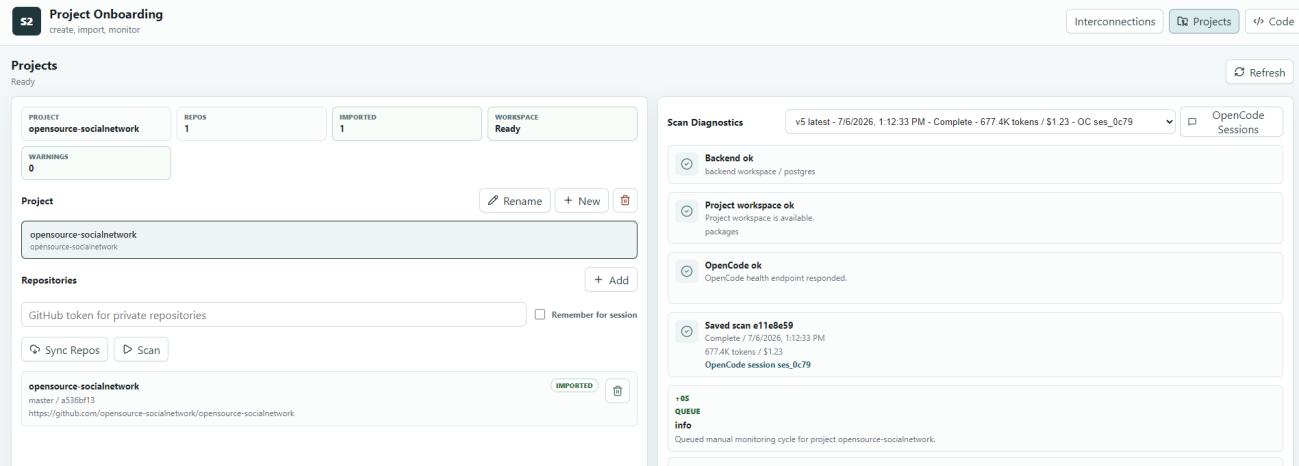
Project onboarding: import or sync repositories, run the scan, and read the diagnostics and cost for each run.
A high-level SysML model is also useful as context for AI agents. Large systems can be difficult for an agent to reason about from raw source code alone, especially when the important behavior is spread across many repositories, services, deployment files, and external dependencies. By generating a fresh architecture snapshot, SysML Repo Modeler gives agents a compact system-level map they can use before making changes, answering questions, planning migrations, or investigating incidents. Instead of rediscovering the shape of the system every time, an agent can start from a current model of the major components and relationships.
SysML Repo Modeler
We developed SysML Repo Modeler as a way to automate the nuances of modeling a complex software stack. Reversing the documentation flow, SysML Repo Modeler analyzes existing multi-repository code and generates a renderer-compatible SysML v2 architecture model. You may have a working system, but the actual architecture can still be unclear. When system knowledge is fragmented across repos and peers your ability to make critical decisions timely becomes harder. By converting architecture into code, SysML Repo Modeler gives teams a shared, explorable representation of how their system fits together over time.
A Message from Clear Fracture
Complex systems are never going away. Clear Fracture exists because we see the need and desire from governments to businesses to aid in the fight for efficiency, the growing battle of information overload, and to provide a solution to the business knowledge that never seems to get written down or kept up to date. We think this tool might be useful to others as it does for us, so we have made this publicly available for download here on our GitHub. Feel free to try it out yourself and give us your feedback! If you're interested in what else we have to offer, check out Belvedere: our Agentic Data Manager.
Clear Fracture is a startup building Belvedere, an agentic data engineering platform that uses agents to build governed, deterministic pipelines—not to be the pipeline.