The Data Mesh promised a revolution: domain teams owning their own analytical data as high-quality, self-serve products. No more central bottlenecks. No more months-long waits for the right dataset. Just autonomous domains delivering trustworthy data that consumers could actually use.
Yet in practice, many organizations watch their mesh fracture—not because the technology fails, but because the surrounding organizational structure and politics quietly erode its utility. Processes emerge that look like “governance” on paper but function as guardrails limiting what data consumers can discover, interpret, or act upon. The result is a decentralized architecture that, in reality, recentralizes control in subtler ways.
This isn’t accidental. It’s the predictable outcome of misaligned incentives and communication structures. In this post we’ll examine why Data Mesh was created, how organizational theory explains its common fractures, the specific mechanisms that limit consumer power, and—most importantly—how agentic data engineering can realign roles so the mesh finally delivers on its promise.
Why Data Mesh Was Introduced in the First Place
By the late 2010s, enterprises were drowning in data lakes and warehouses. Central analytics teams had become bottlenecks: every new consumer request required pipeline changes, schema approvals, and months of engineering time. Data quality suffered. Delivery slowed. Domains closest to the source data had the deepest knowledge but no ownership or incentive to maintain analytical products.
Zhamak Dehghani’s 2019 vision flipped the model. Instead of treating data as a centralized asset, treat it as a product owned by the business domains that generate it. The four principles were elegant1 2:
Domain-oriented decentralized data ownership – Domains manage their own analytical data.
Data as a product – Treat datasets with the same care as software products (discoverable, addressable, trustworthy, self-describing).
Self-serve data platform – Infrastructure that lets domains publish products without central gatekeepers.
Federated computational governance – Global standards enforced as code, not manual committees.
The benefits were immediate on paper. Producers no longer needed infinite engineering resources to build every specialty view consumers demanded; they could focus on high-quality, reusable products. Consumers gained speed and relevance. Silos dissolved. Analytical velocity soared.
One often-overlooked advantage: data producers simply do not have the engineers or domain-specific resources to build every specialized product consumers need. A supply-chain team optimizing delivery routes cannot also maintain 17 different marketing attribution views. Data Mesh was supposed to let producers publish a clean, governed core product—and let consumers compose the rest.
When Structure Meets Politics: Conway’s Law in the Data World
Here’s where theory meets reality. Melvin Conway observed in 1967 that “organizations which design systems are constrained to produce designs which are copies of the communication structures of these organizations.”3 In plain English: your org chart becomes your architecture.
A hierarchical company with siloed departments and top-down control will inevitably produce a monolithic data platform, even if the engineers draw boxes labeled “Data Mesh.” Communication boundaries between marketing, finance, operations, and legal become data boundaries. When those groups must collaborate on shared metrics, friction appears. The mesh’s decentralized promise clashes with the organization’s actual communication patterns, and the architecture bends to the org chart instead of the other way around.
This misalignment manifests as political and incentive-driven erosion. Data producers (domain teams) and data consumers (analytics, strategy, or cross-functional teams) sit in different organizational units. They report to different leaders, are measured on different KPIs, and face different risks.
How the Misalignment Deliberately Erodes Consumer Utility
Two related dynamics stand out in practice.
1. Producers protect their narrative.
Data that could highlight waste, backlogs, or poor performance is politically radioactive. A department whose bonus or reputation depends on “on-time delivery >95%” has zero incentive to expose raw waitlist data that tells a more nuanced (and less flattering) story. The demand for that data almost always comes from someone trying to prove the producing organization is falling short. In response, producers gatekeep, minimize, or obscure. A systematic gray-literature review of 114 practitioner sources found exactly this pattern: domains “may not be keen on providing high-quality data to other domains” when it adds workload without reward.4
2. Producers distrust consumer domain knowledge.
Even when data is shared, producers often believe consumers lack the subject-matter expertise to interpret columns, calculate metrics, or apply business logic correctly. A “naive” metric built without full context can paint an “untrue” picture. The question becomes subjective: How fair should a data product be? Should it be optimized for the producer’s internal truth or the consumer’s use case? Without trust, producers retain interpretive control—vague documentation, minimal contracts, guarded schemas. The same review notes that “effective data usage requires a deep understanding of the data and the proposed use case,” yet provider and consumer expertise remain separated.4
These incentives produce concrete behaviors: data hoarding (“Dragon’s Lair” antipattern), where valuable products are aggressively guarded; “Telepathy Expectation,” where producers assume consumers will magically understand undocumented nuances; and minimal sharing that satisfies the letter of a request while neutering its utility.5 The result is a data product that is technically discoverable but practically useless for compelling analysis.
Inherent Challenges of the Distributed Paradigm (Beyond Politics)
Even without politics, the mesh introduces real operational friction:
Stale or broken downstream products. A consumer builds a derived product on an upstream domain dataset. The producer changes a schema or business rule silently; the consumer’s output becomes stale or incorrect with no clear lineage.
Governance and auditing complexity. Does the consumer’s derived product require the same security, compliance, and quality controls as the source? Producers end up auditing downstream usage—an overhead the original Data Mesh vision never fully anticipated.
Lineage and accountability in a web of products. Tracking end-to-end provenance across autonomous domains quickly becomes a full-time job.
These are not failures of will; they are emergent properties of true decentralization without the right tooling.
Lessons from the Front Lines: The DoD Advana Experience
During my time supporting the Chief Data Office for a geographic combatant command under the Department of Defense’s Advana program, we lived this reality daily. Our customers—other commands and entities within EUCOM—requested fused data products that combined internal operational data with external sources. We acted as middlemen in a classic mesh: consumers → us → producers.
The political battles were constant. The team responsible for childcare availability data refused to provide any dataset that could quantify waiting-list backlogs. Their reasoning was reasonable on its face: “The waitlist is nuanced—tiers, preferences, availability windows.” Our customers simply wanted numbers to justify requesting more providers. We were required to submit detailed use-case descriptions; producers would then deliver the absolute minimum subset they deemed “acceptable.” Negotiation cycles stretched for weeks. The mesh existed on paper, but consumer utility was throttled by design.
This pattern repeated across logistics, personnel, and intelligence domains. The producers weren’t malicious—they were protecting narrative control and ensuring data wasn’t misinterpreted outside their expertise.
Reimagining the Mesh: Agentic Data Engineering at Clear Fracture
It is not time to abandon the Data Mesh. We believe our product Belvedere can enable the Data Mesh to deliver on its promise by re-evaluating the roles and responsibilities of producers and consumers in a platform-agnostic way.
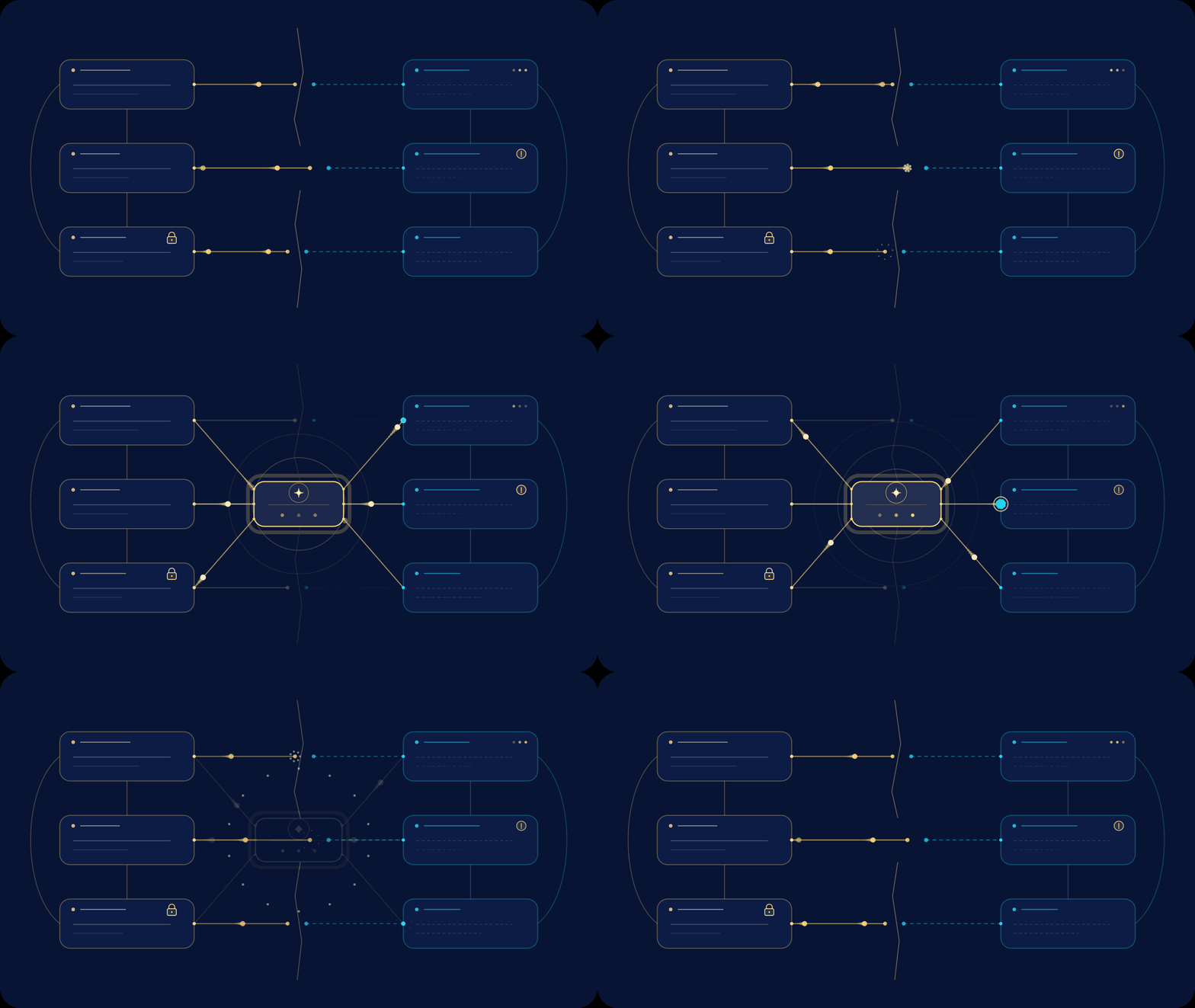
Belvedere is a data platform agnostic agentic data engineering platform designed to work across any ecosystem. Consumers can provide direct input into the construction of a pipeline, essentially building it themselves agentically. The resulting pipeline can then be deployed within the producer’s ecosystem, the consumer’s ecosystem, or a third-party ecosystem. Lineage is tracked seamlessly regardless of the platform.
In addition, the producers’ documentation detailing governance rules can be leveraged by the agents to ensure the pipeline is conformant or to flag use cases that may violate it. This aids the producer’s review process, turning what was once weeks of negotiation into rapid, transparent validation.
This shift has three immediate effects:
Governance and lineage remain enforceable no matter where the pipeline runs, keeping controls where the SME knowledge lives.
Negotiation cycles collapse. Consumers and producers see the proposed product instantly and reach the true crux: Will the producer support this exact use case?
Consumer power is restored without undermining producer control. Data products become useful for the stories consumers need to tell—whether those stories are flattering or critical—because the friction is removed at the source, while producers retain oversight through automated conformance checks.
The mesh no longer fractures under politics; it adapts in real time.
Making Data Mesh Work for Real Organizations
Conway was right: architecture follows communication. But communication—and incentives—can be deliberately reshaped with the right platform. Data Mesh remains the right architectural target. What’s been missing is tooling that respects both the political reality of organizations and the operational complexity of true decentralization.
If your mesh has started to feel more like a guarded labyrinth than a self-serve network, you’re not alone. The patterns we’ve seen across industry, academia, and government deployments are consistent. The fix isn’t more governance theater or another central team. It’s agentic infrastructure that lets domains move at the speed of their business while still delivering trustworthy, usable data products.
We’d love to show you how Belvedere can help your organization close the gap between Data Mesh theory and daily reality. Book a demo6 or reach out at info@clearfracture.ai.
Clear Fracture is a startup building agentic data engineering software that can facilitate many organizations' data requirements; including making decentralized data architectures actually work.
Footnotes
- Thoughtworks, The Data Mesh Shift (whitepaper). https://www.thoughtworks.com/content/dam/thoughtworks/documents/whitepaper/tw\_whitepaper\_data\_mesh\_English.pdf ↩
- Wikipedia, Data mesh. https://en.wikipedia.org/wiki/Data\_mesh ↩
- Wikipedia, Conway's law. https://en.wikipedia.org/wiki/Conway%27s\_law ↩
- “Data Mesh: A Systematic Gray Literature Review,” ACM Computing Surveys (2024). https://dl.acm.org/doi/10.1145/3687301 ↩
- Hannes Rollin, “A Mini-Encyclopedia of Data Mesh Antipatterns, Worst Practices and Curiosa” (Medium). https://medium.com/@hannes.rollin/a-mini-encyclopedia-of-data-mesh-antipatterns-worst-practices-and-curiosa-827b3aae2aa0 ↩
- Clear Fracture — book a demo. https://clearfracture.ai/contact/ ↩