Every capable agent (human or artificial) needs two things before it can act with confidence: a clear picture of where we are, and a robust definition of where we need to go.
That sounds obvious. It is also where most agentic systems quietly fail.
We have poured enormous energy into making models smarter, tools more composable, and orchestration layers more sophisticated. Yet the hard problem is not reasoning in the abstract. It is grounding that reasoning in a faithful account of the present (here) and an unambiguous specification of the intended future (there). Without both, an agent is improvising. With both, it can plan, execute, verify, and explain.
Agents Don't Need Magic. They Need Context with Edges.
An AI agent assisting a mission, a business process, or a data pipeline is only as good as the situation it can see and the outcome it is asked to produce. "Current state" is not a chat transcript. "Goal" is not a vague aspiration. Both must be detailed enough that another competent actor (software or human) could inspect them, challenge them, and act on them.
That means capturing:
Here: what exists now (systems, sources, constraints, policies, dependencies, quality, ownership, and known gaps). Not a slide. Not a tribal memory. Ground truth.
There: what "done" looks like (required outcomes, acceptance criteria, interfaces, governance rules, and the boundaries the agent must not cross).
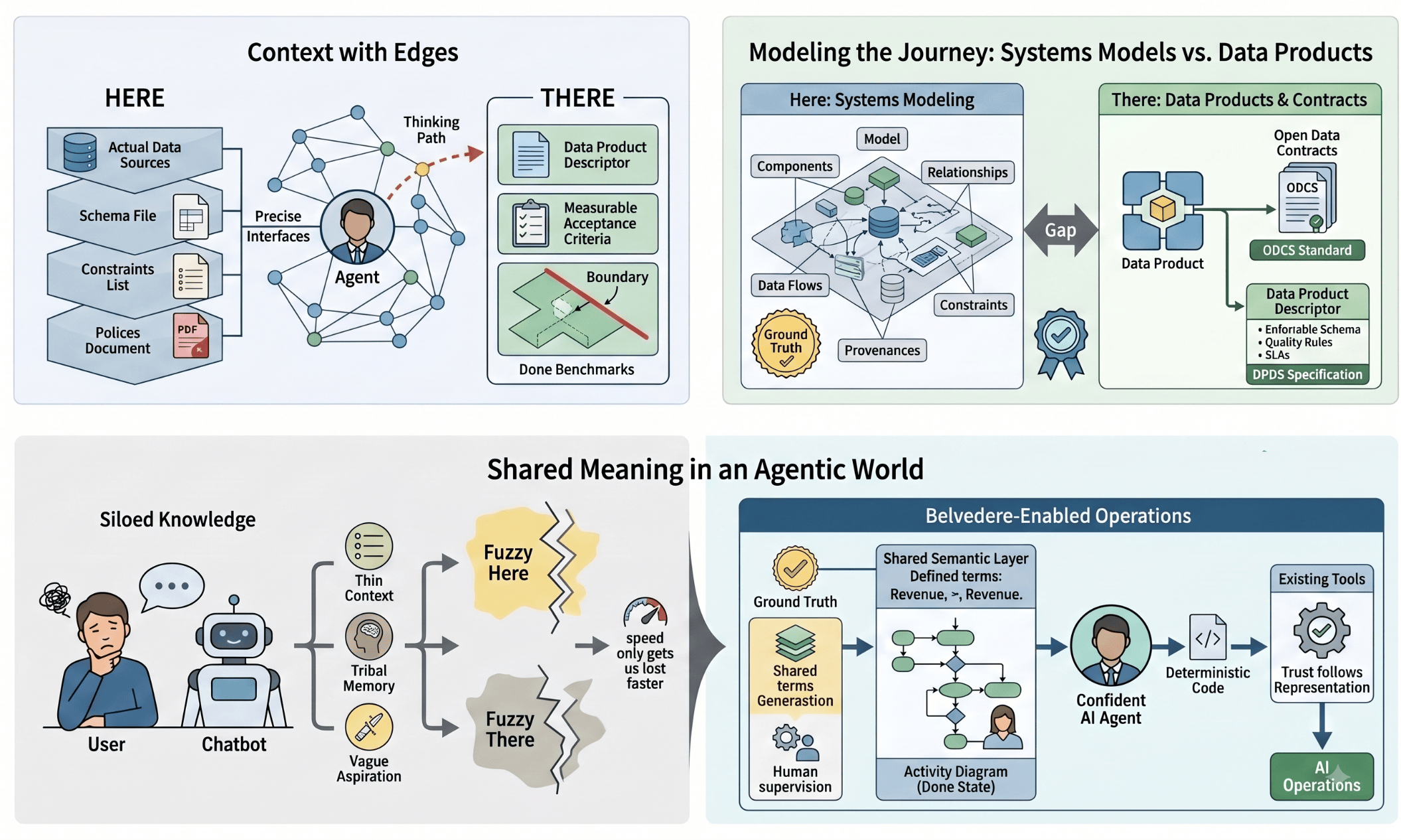
The distance between those two poles is the work. Everything else (prompts, tools, workflows) is how we travel. If here and there are fuzzy, speed only gets us lost faster.
This is not a fringe intuition. Researchers at Carnegie Mellon University's Software Engineering Institute have long argued that AI-enabled capability must be evaluated in system context - not as a clever model in isolation, but against negotiated requirements, quality attributes, and the constraints of the larger system in which it will operate. Their Machine Learning Test and Evaluation work makes the point concrete: vague intent must be turned into measurable requirements before teams can claim readiness. Likewise, SEI researchers applying system-theoretic approaches such as System Theoretic Process Analysis remind us that complex systems fail through unsafe interactions and design gaps, not merely through component error. In an agentic world, that lesson scales: the agent is only as trustworthy as the system picture and success criteria surrounding it.
Representation Is the Real Challenge
The deeper insight is this: the bottleneck is rarely "can the agent think?" It is "can we represent here and there in a form that is complete enough to trust and precise enough to execute?"
Natural language helps us start. It does not finish the job. Ambiguity that humans paper over in meetings becomes brittle instructions for machines. Spreadsheets and ticket queues capture fragments. Architecture diagrams go stale the week they are drawn. Policy PDFs sit beside systems that no longer match them.
What we need is a disciplined way to model both poles of the journey - not as documentation theater, but as living, machine-usable structure.
Systems modeling is the natural answer.
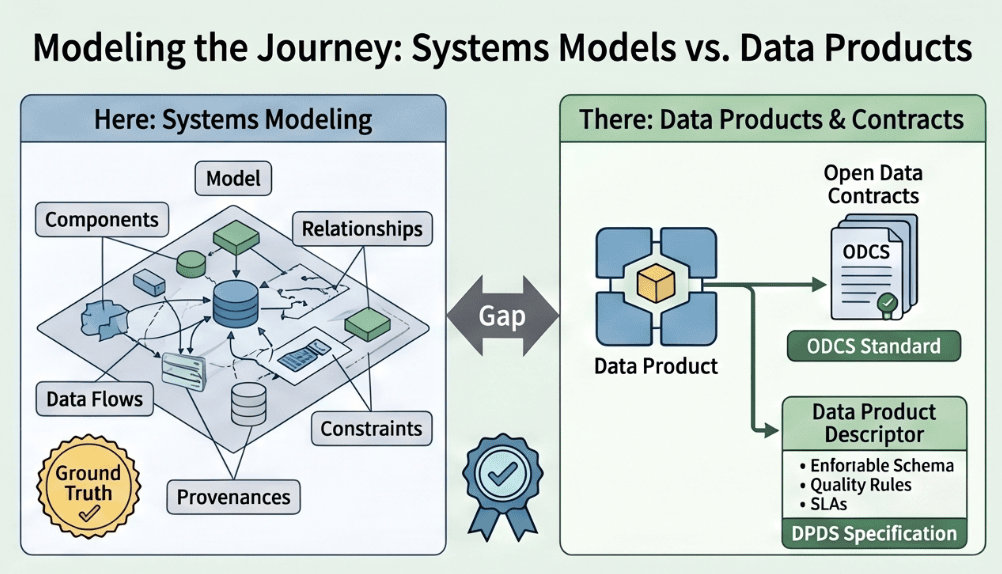
A systems model of the current environment can encode ground truth (components, relationships, data flows, constraints, and provenance). A second model (or a deliberate delta against the first) can encode the desired state (the target architecture, the required data product, the governed outcome). Once here and there are represented as models, agents are no longer guessing from prose. They are navigating a defined gap with inspectable assumptions.
That is how you get assistance that is not only fast, but accountable.
Industry is already converging on this representation problem from adjacent angles. The Open Data Mesh Initiative's Data Product Descriptor Specification (DPDS) treats the data product itself as a declarative, technology-agnostic document - explicitly designed so both human agents and digital agents can discover, understand, and interact with it with minimal cognitive load. In parallel, the Linux Foundation's Bitol project has advanced the Open Data Contract Standard (ODCS) and complementary Open Data Product Standard (ODPS) work: contracts that make producer-consumer agreements enforceable (schema, quality rules, SLAs, roles, and expectations) rather than leaving "desired state" as tribal knowledge. These efforts share a thesis with systems modeling: if there cannot be stated in a form tools can validate, agents cannot be trusted to close the gap.
Semantic-layer advocates make a related claim on the meaning side of the same problem. Whether through LookML's modeling tradition, dbt's Semantic Layer and MetricFlow, Cube's headless metrics model, or the broader push for governed metric definitions as code, the argument is consistent: AI agents pointed at raw tables will invent joins, redefine "revenue," and hallucinate confidence. Agents pointed at a governed semantic layer inherit shared meaning. In other words, here is not only what tables exist; it is what those tables are allowed to mean. There is not only a deliverable; it is an outcome measured against definitions the organization already agreed to.
The Burden We Pretend Is Inevitable
If systems models, data product descriptors, contracts, and semantic definitions are so powerful, why aren't they everywhere?
Because creating and maintaining them has historically been expensive, specialized, and slow. Traditional tooling and methods turn modeling into a specialist craft (steep learning curves, brittle diagrams, and models that drift from reality the moment the organization moves). Teams either skip modeling and hope tribal knowledge holds, or they invest heavily and still struggle to keep models current enough to drive action. The same pattern appears in contract and semantic-layer adoption: the value is clear; the capture-and-sustain cost is the blocker.
In an agentic world, that burden is no longer a niche inconvenience for model-based systems engineers or data governance specialists. It becomes a strategic liability. Agents amplify whatever representation we give them. Feed them thin context, and they will act confidently on incomplete truth. Starve them of a crisp there, and they will optimize the wrong thing with impressive fluency.
The innovation we need is not another generic chatbot layered on yesterday's ops. It is a new way to capture, sustain, and reason over models of here and there - at the speed of change, with humans still in control of what "good" means.
Preparing for an Agentic World We Can Trust
Operating with confidence and responsibility among agents means treating representation as first-class infrastructure. We should expect:
Continuous discovery of ground truth, not periodic archaeology
Goals expressed as contracts, descriptors, and models - not only as tickets
Shared semantic definitions so agents reason over governed meaning, not invented metrics
Transparent reasoning over the gap between current and desired state
Execution that remains deterministic where it matters (especially when data integrity and governance are on the line)
That is how organizations move from "AI experiments" to "AI operations" without surrendering accountability. It is also the through-line connecting SEI's system-centric assurance work, open standards for data products and contracts, and the semantic layer movement: trust follows representation.
Belvedere™: Closing the Gap for Data Ops
Clear Fracture's Belvedere is tackling this challenge head-on for data operations.
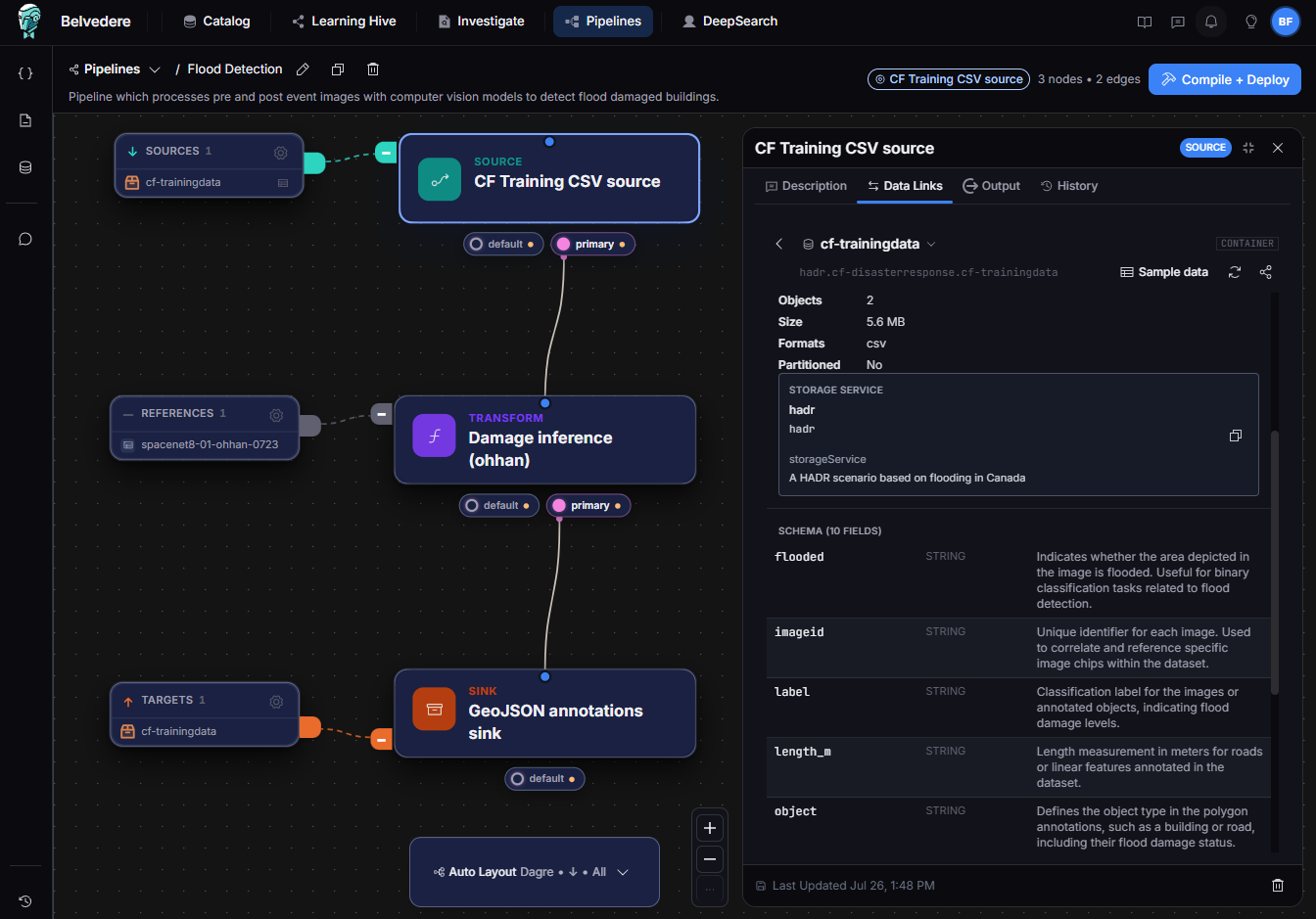
Belvedere is built on the premise that agentic assistance in data work only becomes trustworthy when here and there are made explicit. It continuously learns the living ground truth of an organization's data landscape (sources, schemas, contents, provenance, and constraints) so the current state is not guessed from memory. Users then define desired outcomes in forms agents can actually use (plain language, visual activity diagrams, and data contracts). From there, Belvedere reasons through systems models to design the path from here to there, generates the pipeline logic required to close that gap, and compiles it into deterministic code that runs on the tools you already trust.
In other words: Belvedere does not ask an agent to "figure out data ops." It equips agents (and the people who supervise them) with durable representations of where data operations stand and where they must arrive. That is how you get speed without hallucination, automation without black boxes, and progress you can defend.
From here to there was always the whole problem. Academia and industry are increasingly clear that the decisive work is how we capture and represent both ends of that journey. In an agentic world, the winners will be those who can model here and there - and keep those models honest as reality changes.
Belvedere exists to make that possible for the people who move data from sensing to decision.
Book a demo to see how Belvedere models here and there for your data operations, or reach us at info@clearfracture.ai.